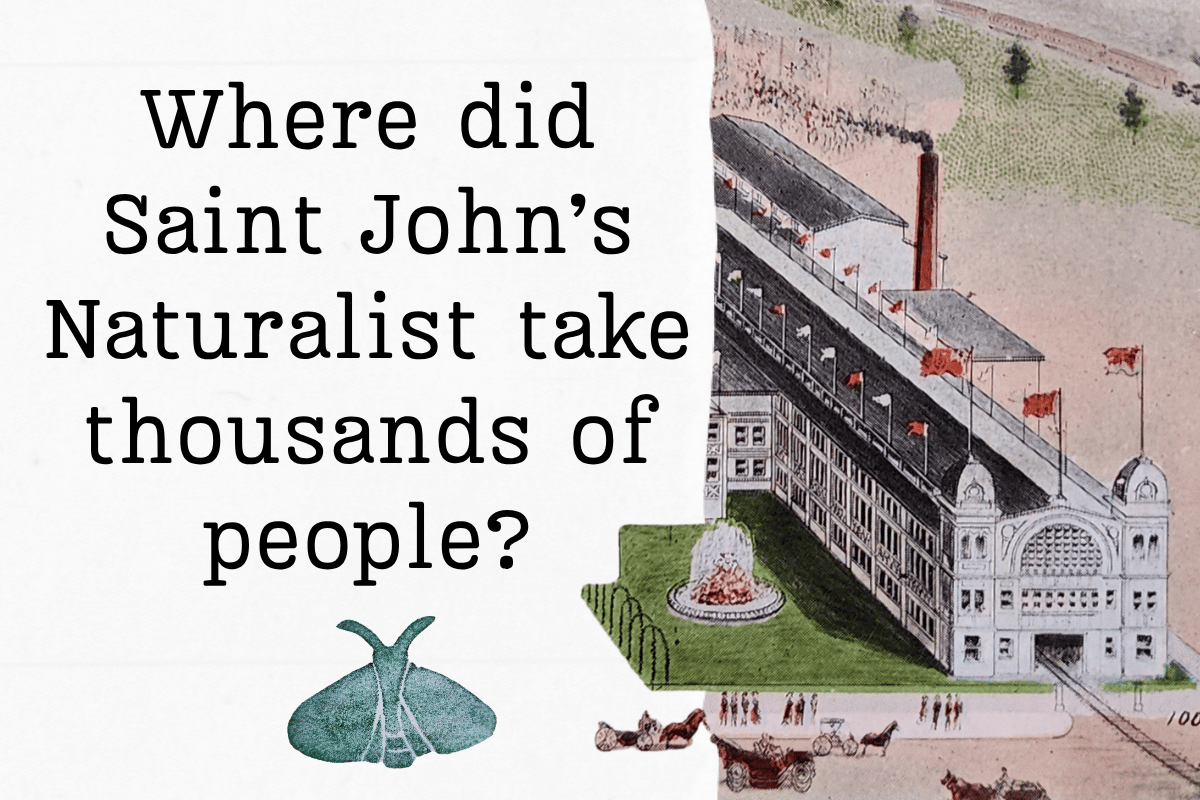
Welcome to the wondrous world of William McIntosh. Previously, we’ve been whirling through the newspapers, reading 1888 headlines about his unique pet snakes1 and 1897 columns dedicated to his artistic gardening endeavours2. Wander with me as we paddle into William’s future. Where do you think he will go next?
Curious about his snake charmer phase? Start your journey at the beginning.
A Saint John History Mystery – Vol. 3, No. 1, Pt. 3
Part Three: The River
The Interest In Insects Begins

You might think that after a full day caring for plants and protecting leaves from slugs and bugs, William would want a break. Instead, as reported in the September 1899 St John Sun, he showcased his large collection of native insects mounted on the walls of that year’s Exhibition Natural History section.3
Image Source: Author’s collection.16
Scientifically classified accordingly so farmers and gardeners alike could learn more about the beneficial and destructive insects. Excitingly, William was awarded first place in all three related categories. However, he was also the only entry.4
During this time, the Natural History Society of New Brunswick Bulletins noted that he was an active member, sharing his insect insights on butterflies, moths, and other native species. The society kept him busy; in 1898, he rearranged and remounted their entire insect collection while serving on the Zoological Committee and he was listed as one of the curators.5

Image Source: The White-marked Tussock Moth (1917), William McIntosh. Illustration after Howard, U.S. Department of Agriculture. Canadiana (CRKN).25

Image Source: Bulletin of the Natural History Society of New Brunswick, No. XVI (1897/98), p. 82. Canadiana (CRKN).6
That same year, William’s passion really showed as he, along with his brother Philip and Mrs. S. B. McPherson, added over 500 new specimens to the collection.6
Museum Momentum
Throughout his thirties, his interest in insects continued to make the news. William found the first Brown-tailed moth in Canada in 1902.7 This was a serious topic in forestry and with fruit trees, as this flying pest damaged trees.8 The momentum of firsts kept going. The next year, he published the first list of New Brunswick flies. From this list, the newspaper reported that fourteen of them were new specimens added to Washington’s National Museum collection.9 As an insect expert, he lectured at many industry events, including the 1906 Fredericton New Brunswick Fruit Growers Association annual meeting.10 The next year, the Natural History Society’s Museum had a new home on Union Street, and William moved in as the resident curator.12 That year, the society applauded William’s dedication by making him a life member. 11

Image Source: Brown-tail Moth (Euproctis chrysorrhoea), A Manual of Dangerous Insects (1917). Biodiversity Heritage Library..26

Image Source: The Evening Times (Saint John, New Brunswick), July 15, 1908, p. 8. New Brunswick Historical Newspapers Project, UNB Archives & Special Collections.7
Decades later, the society transformed into the New Brunswick Museum, and his role as curator evolved into a director position.12 As a recognized expert in his field, the University of New Brunswick presented him with an honorary degree of Science and, years later, a doctorate. It’s clear that William loved learning and kept doing so.13 32

Want to know more about William’s career at the museum? Check out this paper, “William MacIntosh, Natural History and the Professionalization of the New Brunswick Museum, 1898-1940” by Lianne McTavish & Joshua Dickison, University of New Brunswick
Image Source: Provincial Archives of New Brunswick, P279\3.27
Continuously Inspiring Curiosity in the Community
Throughout his life, he shared the knowledge he gathered with the community, giving regular talks to schoolchildren, youth groups, society groups, and the general public. In 1910, in his first few years as resident curator at the Natural History Society, he welcomed children from local schools each Friday to learn about the natural world around them.14 Even into his 80s, he was delighting groups with history and nature lore. One winter evening decades later, in 1949, he captivated a Saint John Girl Guide group with tales of his camping adventures on the St. John River (Wolastoq). Later that year, they were invited to learn more outside the city at his summer camp on the Nerepis River. 15

This is one of the bugs A. Gordon Leavitt caught in Nerepis and later was named after him.
Image Source: Smithsonian Institution, National Museum of Natural History, Department of Entomology. USNMENT00779136.28

Image Source: St. John Star (Saint John, New Brunswick), August 22, 1905, p. 6. New Brunswick Historical Newspapers Project, UNB Archives & Special Collections. 17
Owned by both William and his long-time friend A. Gordon Leavitt, “Camp Nature” was a popular welcoming place. This collecting camp started as a destination for finding bug specimens. Only a train ride away from the city, the Natural History Society hosted field days and picnics there. Even in the early days, these trips attracted large groups. The newspapers noted that in 1906, the Grand Bay train kindly made an extra stop for William, letting off sixty-one members just a short walk from the camp.17 16

Image Source: Provincial Archives of New Brunswick, P599\1086.29

Image Source: Provincial Archives of New Brunswick, P599\1080.30
William led other educational excursions beyond the camp, up the St. John River (Wolastoq). He loved getting people out of the city to explore nature, which evolved into annual canoe trips to Grand Lake. He often supplied the key equipment, including canoes and camping gear. The trips were so popular and supported locally that the CNR even provided a special boxcar to transport the group and canoes to Gagetown. It must have been quite the cheerful sight as the city folk splashed up the river, many in a canoe for the first time. The journey would have been packed with fun facts. He discussed local tales, legends, tidbits about the geology, trees, and landscapes they were travelling through. Sharing what he knew about First Nations culture and history in the area. At night, they would search the stars for constellations. The next day, they returned to the water, occasionally stopping along the way to highlight and collect surface artifacts and rock samples. Once they brought back an almost milk crate-sized agate! That must have been heavy to carry along with the canoes. 24 Newspapers published details and updates about the many summer journeys he guided. The ripple effect of the canoe trips over half a century was felt by thousands of people across Canada and the United States. A love for outdoor exploration was passed down through generations, as many new campers’ parents had gone on the same journey with William. 18 19

Even in his later years, he kept guiding groups. In the summer of 1949, an excited group of 40 teens from the city travelled with William in 16 canoes. During this summer of canoe-camping trips, newspapers reported that the kids called him “Doctor Mac” or “Mister.” Touring 109 miles for roughly 3 weeks didn’t slow this 80-year-old down.19
Image Source: Saint John Times Globe (Saint John, New Brunswick), July 30, 1949, p. 11. Newspapers.com.19
A few days later, he was back on the river. This time 10 nurses joined him on another canoe venture for a week-long excursion on the Belleisle River.20 Unfortunately, he did not return to the river in the summer of 1950, as in April of that year he passed away at the General Hospital. In honour of William, Miss Gladys Bell led a two-week canoe trip the next year, taking some high school “youngsters” up to Grand Lake. 21
A Lifetime of Learning
It’s fascinating to flip through William’s life as it unfolded in the community interest section of the local newspapers. In his earlier years, he had an inquisitive quest to gather and tame snakes. A fixation that would later blossom into catching and studying creatures that crawl and flutter. As the newspaper features kept coming, I enjoyed reading about how he volunteered with his father to beautify King and Queen Square. As his gardening skills grew, so did his achievements. The papers raved about his artistic landscaping skills while he worked for Mr. Allison, co-owner of one of Saint John’s largest department stores. William’s life story was woven through so many Saint John’s societies and groups.

His enthusiasm and sense of curiosity led him from snakes and bugs to curating the Natural History Society of New Brunswick and later the New Brunswick Museum. According to the newspapers, he always looked to share his spark of wonder with the community through talks, outreach with youth groups, and outdoor adventures.
Image Source: Provincial Archives of New Brunswick, P599\1094. 31
I feel like his life is a great example of how powerful curiosity is and how important it is to hold on to it, no matter your age. To me, he feels like the Kratt Brothers of his time. I grew up watching Zoboomafoo, with the Kratt Brothers sharing fun nature facts. Now my kid watches the original Zoboomafoo on YouTube with wonder, along with the newer Wild Kratts animated series. It’s cool that over 100 years before the first Zoboomafoo episode aired on PBS, Saint John’s own naturalist got his (seemingly first) front-page feature about his pet snakes.22

Want to learn about William’s passion for plants? Turn back time with Part 2

History Mysteries explores the people, places, and events of Saint John and other places in the Maritimes’ past through newspapers, maps, photographs, city directories, and other historical records. While every effort is made to verify information through multiple sources, some historical details remain open to interpretation as new evidence comes to light.
Research Note: Historical records (Newspapers, directories, death certificates, headstones and other records) varied in the spelling of the surname MacIntosh and McIntosh. For example, many newspapers used McIntosh; Donald’s death certificate listed McIntosh, while William’s was MacIntosh and the family headstone was MacIntosh.
Sources
1Progress (Saint John, New Brunswick: 1888) “OUR OWN SNAKE-CHARMER” 1, no. 19, September 08, 1888: [1]. New Brunswick Historical Newspapers Project, accessed July 02, 2026, https://newspapers.lib.unb.ca/serials/155/issues/22468/pages/162689.
2The Telegraph-Journal (Saint John, New Brunswick: 1897) “Something Worth Seeing.” August 30, 1897. Page 3. Newspapers.com, accessed July 16, 2026. https://www.newspapers.com/article/telegraph-journal-something-worth-seeing/204546231
3 The St. John Semi-Weekly Sun (Saint John, New Brunswick: 1899) “The Exhibition, Monday’s Proceedings.” September 20, 1899. Page 4, “Natural History Department.” University of New Brunswick Libraries Historical Newspapers. Accessed July 30, 2026. https://newspapers.lib.unb.ca/serials/99/issues/48665/pages/437121?
4 The Telegraph-Journal (Saint John, New Brunswick: 1899) “And Now the End, Exhibition Closes with Some Special Features Today.” September 20, 1899. Page 1, “Prize List Natural History Department.” Newspapers.com, accessed July 30, 2026. https://www.newspapers.com/article/telegraph-journal-and-now-the-end-exhib/209343349
5 Bulletin of the Natural History Society of New Brunswick, No. XVI (1897/98), p. 89. Canadiana (CRKN). https://www.canadiana.ca/view/oocihm.8_00549_16/92
6 Bulletin of the Natural History Society of New Brunswick. No. XVI (1897/98). Page 82. Canadiana, accessed September 21, 2026. https://www.canadiana.ca/view/oocihm.8_00549_16/85
7The Evening Times (Saint John, New Brunswick: 1908). “The Brown Tail Moth.” July 15, 1908. Page 8. New Brunswick Historical Newspapers Project, accessed September 22, 2026. https://newspapers.lib.unb.ca/serials/62/issues/16225/pages/123516
8The Evening Times (Saint John, New Brunswick: 1907). “Recorder Skinner and William McIntosh Spoke to Natural History Society Last Evening.” February 27, 1907. Page 8. New Brunswick Historical Newspapers Project, accessed September 22, 2026. https://newspapers.lib.unb.ca/serials/62/issues/15923/pages/121007?
9St. John Star (Saint John, New Brunswick: 1903). “Publication.” May 2, 1903. Page 5. New Brunswick Historical Newspapers Project, accessed September 27, 2026. https://newspapers.lib.unb.ca/serials/279/issues/50823/pages/451159?
10St. John Semi-Weekly Sun (Saint John, New Brunswick: 1906). “Annual Meeting of the NB Fruit Growers.” January 27, 1906. Page 1. New Brunswick Historical Newspapers Project, accessed September 27, 2026. https://newspapers.lib.unb.ca/serials/99/issues/48892/pages/438944?
11The Evening Times (Saint John, New Brunswick: 1907). “Honors for Two Earnest Workers.” January 16, 1907. Page 5. New Brunswick Historical Newspapers Project, accessed September 27, 2026. https://newspapers.lib.unb.ca/serials/62/issues/15979/pages/121474?
12Telegraph-Journal (Saint John, New Brunswick: 1950). “Dr. Wm. MacIntosh Famous Naturalist, Dies In Saint John.” April 21, 1950. Page 16. Newspapers.com, accessed September 27, 2026. https://www.newspapers.com/article/telegraph-journal-dr-wm-macintosh-famo/209343609/
13Telegraph-Journal (Saint John, New Brunswick: 1921). “Honor Well Merited.” May 14, 1921. Page 10. Newspapers.com, accessed September 27, 2026. https://www.newspapers.com/article/telegraph-journal-william-mcintosh-degre/209343722/
14The Evening Times (Saint John, New Brunswick: 1910). “Morning Locals.” January 8, 1910. Page 9. New Brunswick Historical Newspapers Project, accessed September 28, 2026. https://newspapers.lib.unb.ca/serials/62/issues/16749/pages/127598?
15Telegraph-Journal (Saint John, New Brunswick: 1949). “Addresses Guides On River History.” February 17, 1949. Page 16. Newspapers.com, accessed September 29, 2026. https://www.newspapers.com/article/telegraph-journal-girl-guides-dr-macint/209343854/
16St. John Star (Saint John, New Brunswick: 1905). “Natural History Field Day.” August 22, 1905. Page 6. New Brunswick Historical Newspapers Project, accessed October 4, 2026. https://newspapers.lib.unb.ca/serials/279/issues/51198/pages/453299?
17The Evening Times (Saint John, New Brunswick: 1906). “Natural History Society Outing.” August 20, 1906. Page 7. New Brunswick Historical Newspapers Project, accessed October 5, 2026. https://newspapers.lib.unb.ca/serials/62/issues/15591/pages/118177?
18Saint John Times Globe (Saint John, New Brunswick: 1949). “To Start Canoe Trip Saturday.” July 28, 1949. Page 13. Newspapers.com, accessed October 13, 2026 https://www.newspapers.com/article/saint-john-times-globe-macintosh-canoe-t/209344064/
19Saint John Times Globe (Saint John, New Brunswick: 1949). “Dr MacIntosh And Party of 40 Canoeists Starting On Annual Trip Today.” July 30, 1949. Page 11. Newspapers.com, accessed October 13, 2026. https://www.newspapers.com/article/saint-john-times-globe-dr-macintosh-40/209344202/
20Telegraph-Journal (Saint John, New Brunswick: 1949). “His Rests Are Brief.” August 20, 1949. Page 16. Newspapers.com, accessed October 13, 2026. https://www.newspapers.com/article/telegraph-journal-dr-macintosh-his-rest/209344297/
21Telegraph-Journal (Saint John, New Brunswick: 1951). “Canoeists Head Homeward After Grand Lake Visit.” August 16, 1951. Page 11. Newspapers.com, accessed October 13, 2026. https://www.newspapers.com/article/telegraph-journal-miss-gladys-canoe-tri/209344375/
22Wikipedia contributors. “Zoboomafoo.” Wikipedia, The Free Encyclopedia. Accessed October 13, 2026. https://en.wikipedia.org/wiki/Zoboomafoo#:~:text=A%20creation%20of%20the%20Kratt,collection%20of%20returned%20animal%20guests.
23“Aeroplane View of the Exhibition Buildings, St. John, N.B.” Postcard. Valentine & Sons United Publishing Co., Ltd., Montreal and Toronto. Serial no. 100154. c. 1903-1905. Author’s collection.
24Saint John Times Globe (Saint John, New Brunswick: 1949). “This Day in History.” August 29, 1949. Page 4. Newspapers.com, accessed October 30, 2026 https://www.newspapers.com/article/saint-john-times-globe-dr-william-macint/209344521/
25McIntosh, William. The White-marked Tussock Moth Hemerocampa leucostigma (Sm. & Ab.). Fredericton: New Brunswick Department of Agriculture, Publication No. 34, 1917. Illustration after Howard, U.S. Department of Agriculture. Canadiana, accessed October 27, 2026. https://www.canadiana.ca/view/oocihm.83615/6
26U.S. Bureau of Entomology. A Manual of Dangerous Insects. 1917. Brown-tail Moth (Euproctis chrysorrhoea) illustration. Biodiversity Heritage Library, accessed October 27, 2026. https://www.biodiversitylibrary.org/item/273807#page/146/mode/1up
27Provincial Archives of New Brunswick. Picture Panels of Saint John, New Brunswick. “The New Brunswick Museum, Saint John, N.B., Canada.” P279\3. 1930s. https://archives.gnb.ca/en-ca/collections/details?level=5&key=562357
28Smithsonian Institution, National Museum of Natural History. Pontania leavitti Rohwer, 1910. USNMENT00779136. https://www.si.edu/object/pontania-leavitti:nmnhentomology_9170864
29Provincial Archives of New Brunswick. T. Clifford and Clara Hodgson fonds. “Nerepis River.” P599\1086. 1949. https://archives.gnb.ca/en-ca/collections/details?level=5&key=762521
IMAGE 30Provincial Archives of New Brunswick. T. Clifford and Clara Hodgson fonds. “Nerepis River.” P599\1080. 1949. https://archives.gnb.ca/en-ca/collections/details?level=5&key=762515
31Provincial Archives of New Brunswick. T. Clifford and Clara Hodgson fonds. “Nerepis River.” P599\1094. 1949. https://archives.gnb.ca/en-ca/collections/details?level=5&key=762529
32Saint John Times Globe (Saint John, New Brunswick: 1934). “Dr. WM. MacIntosh To Get Honorary Degree at U.N.B.” May 16, 1934. Page 13. Newspapers.com, accessed November 1, 2026. https://www.newspapers.com/article/saint-john-times-globe-dr-wm-macintosh/209497891/
